Product decisions need more than an agent.
pm.gold is the governed system of record for product evidence, decisions, and outcomes. Use ChatGPT, Codex, Claude, or any model to do the work — pm.gold preserves what supported it, who approved it, what shipped, and whether it worked.
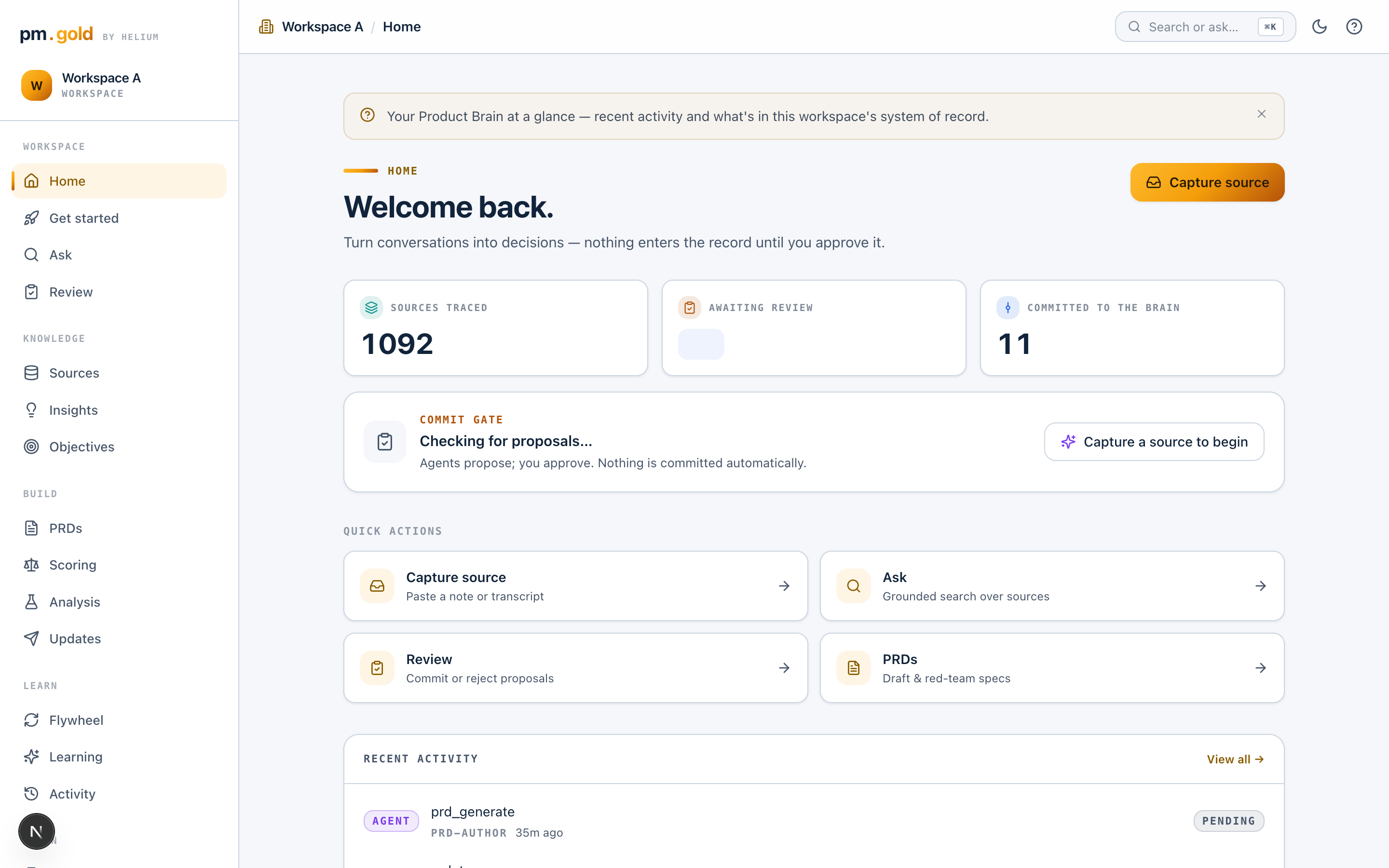
What only a system of record can do
Four questions an agent can’t answer for you.
Not because the model isn’t good enough — because the answer isn’t in a conversation. It’s in a governed record.
Defend any decision
“Why did we build this, and who approved it?”
Walk any requirement backwards: the evidence it cites, the sections that honestly had none, the precedent that informed it, every version, and the human who committed it — with separation of duties on the record.
Intent vs. reality
“Did we ship what we approved?”
Compare the approved PRD clause by clause against implementation evidence. Each gap is filed as a proposal at the gate — surfaced, not quietly lost between the spec and the sprint.
Learn from decisions
“Have we tried this before, and did it work?”
A new draft recalls similar past decisions and their recorded outcomes — won or lost — and the corrections your team keeps making. Precedent is linked to the draft it shaped, so the learning is auditable.
Catch the drift
“What did we decide that is no longer true?”
Committed decisions keep watching the evidence beneath them. When a cited source moves, every decision still standing on the old version is listed — by query over the record, not by a model’s judgment. Each arrives as a proposal at the gate, capped by a weekly interrupt budget so it stays signal.
Each answer is assembled from committed rows — never generated. Where a step hasn’t happened yet, pm.gold says so rather than implying it.
The problem
Your agents are getting better. Your decision record isn’t.
ChatGPT and Claude now remember context and cite connected sources. What none of them keep is a governed record of what your team actually approved — the evidence behind it, who signed off, what shipped, and whether it worked. As agents write more of the work, that record is what gets scarce.
of a PM’s time goes to unplanned firefighting.
Product Focus, 2024
use AI where they need it most — shifting priorities.
Atlassian, 2026
worry their product won’t succeed in the market.
Atlassian, 2026
How it works
One loop — and it doesn’t end at the record.
Agents do the work; the Brain holds the truth. Every step is typed, versioned, and traceable to the source that drove it — and the last step points back at the third.
Capture
Meetings, calls, docs, tickets — ingested as evidence.
Reason
Agents cluster signals and draft, grounded in the Brain.
Propose
PRDs, scores, decisions — supported claims cited, gaps flagged.
Gate
A human approves or rejects. Nothing is automatic.
Record
Approved work enters the append-only Brain.
Watch
Decisions keep watching their evidence. Change returns to step 03.
Nothing enters the record until a human approves it. The commit gate is the product, not a setting.
The record checks itself
Evidence changes. Most records never notice.
A decision is only as good as what it rests on. Six months later the pricing page it cited has changed and the competitor it assumed has moved — and the document still reads exactly as confident as the day it was approved. That isn’t a documentation problem. It’s the failure mode of every decision record ever kept.
pm.gold commits a decision with its assumptions attached. Each one names what would have to be true, and what would prove it false. Watched pages are re-fetched on a schedule and diffed. A change that matters becomes a proposal at the same gate everything else goes through — nothing is edited automatically, and nothing is quietly dropped.
It’s allowed to interrupt you a fixed number of times a week. That budget is the feature, not a limitation of it. A system that can raise an alarm whenever it likes becomes noise inside a month — and noise is worse than silence, because silence is at least honest about how much it knows.
The Contradiction Ledger
A decision cited version 1; that source is now on version 4. Finding the decisions standing on the old evidence is a query over the record — not a model’s opinion about whether something still holds.
Ledger Health
What share of your committed decisions still rest on current evidence — and the negative space beside it: the objectives you hold no evidence about at all. A record can be wrong by being silent.
It learns what you ignore
What you dismiss at the gate feeds back into what gets surfaced. The calibration can only ever damp a category, never amplify one — so the loop can quiet itself down and has no path to shout.
Once a week, the same record tells you what’s waiting for you and what has gone stale — to your own inbox, or your own Slack. Counts, titles and links; never the evidence text.
Capabilities
Everything a PM touches — captured & cited.
Meeting capture
Transcripts turned into decisions, actions, and PRD-ready snippets — each timestamped to its source.
PRD generation
Draft from evidence with inline citations, then red-team and ship-check before it ships.
The commit gate
Agents propose; a human approves. Every decision and override recorded in an immutable audit.
Why pm.gold
Not another tool. The most trusted voice in the room.
A typed decision graph
Not notes in a chat history: meetings, signals, decisions, PRDs, risks and outcomes as typed nodes with append-only versions and traversable evidence chains. Every artifact knows what it rests on.
Learns from your approvals
pm.gold captures what humans change between the draft and the approved version, distills governed calibration rules, and applies them to future work. Early controlled tests reduced later editing while grounding held flat — directional, and we report it that way.
Your record outlives the model
Models swap behind a clean seam, so every leap in AI is an input rather than a migration — and your decision history never lives inside one vendor’s memory.
Security & trust
Enterprise-grade by construction, not by checklist.
The guarantees are enforced in the data layer — so they hold even when something above them has a bug.
SSO — Entra & Google
Sign in through your identity provider, bound to your tenant.
Immutable audit
Every decision and override is recorded and can’t be edited or deleted.
Tenant isolation, fail-closed
Enforced in the data layer — row-level security on every content table, failing closed by default. Dedicated single-tenant deployment available for Enterprise.
Grounded & defensible
Every AI claim cites its source — nothing asserted that can’t be traced.
FAQ
Questions, answered honestly.
The short version. For the full, honestly-labeled security posture, see the Security page.
What is pm.gold?
How is it different from ChatGPT, Codex, or Claude?
Does it make things up? How do I trust the output?
Who is it for?
How do we get our context in?
Is our data used to train AI models?
Can we use pm.gold from Claude or ChatGPT?
Will it tell me when a decision we made is no longer safe to rely on?
How is access controlled? Is our data isolated from other companies?
How do we sign in?
Which AI models does it use?
Are you SOC 2 certified?
Can it connect to our existing tools?
How do we get started?
Still have questions? Request a demo →
The gold standard
Give your best decisions a gold standard.
We’re onboarding design-partner teams now. Book a walkthrough and we’ll stand up your workspace.